Thursday, May 27, 2021

More types of Foundations.

 (3) Concrete Column Footing:

Column footing may be isolated (for single column) or combined (for more than one column) It is made up of reinforced cement concrete and hence called RCC footing, RCC footing is used for columns and walls carrying heavy loads or at the places where the hearing capacity of the soil is low. This footing can be square, rectangular or circular. It may be of uniform thickness or sloped as shown in Fig. 2.5. This type of footing is constructed over an 80 mm thick layer of lean concrete. The minimum thickness of RCC footing is 150 mm Reinforcement in the form of bars is placed near the bottom face of the footing in both directions as shown in Fig. 2.5.

Picture of Cross sections of a r.c.c Foundation

Picture of Cross sections of a r.c.c Foundation
Fig 2.5 R.C.C Foundation.


(4) Inverted Arch Footing:

Inverted arch footing is used in bridges, reservoirs, or support for drainage lines. It is not used in buildings. This footing provides a larger area for the distribution of superstructure load to the soil as shown in Fig. 2.6.

cross section picture of inverted arch foundation
Fig. 2.6 Inverted Arch Foundation.

In this type of footing, special attention is given to strengthening the end pier by constructing a buttress that can counter the horizontal thrust transmitted by the end arch to the end pier. Inverted arch footing has the advantage that the depth of foundation is greatly reduced, especially in the case of soft soils. These footings are not used nowadays because of their skilled construction.

2.4.2. Combined Footing:

A combined footing is provided for two or more columns together under the following circumstances:

1. When one of the columns is located near the property line and the individual footings of the columns may extend outside the property line.

2. When the individual footings of the columns overlap each other due to proximity.

3. When the required area of an individual footing is more due to low bearing capacity of the soil.

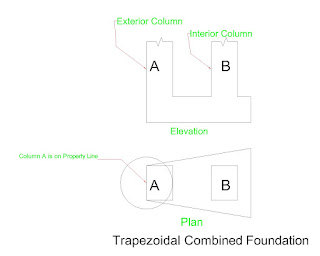
This footing maybe rectangular if the two columns carry equal loads and trapezoidal if columns carry unequal loads as shown in Fig. 2.7.


elevation and plan of a combined foundation


    2.4.3. Raft Foundation:

    It is a type of shallow foundation which is most suitable for heavy structures to be built on soft and marshy soil types which can cause differential settlement of the building. The Raft foundation consists of R.C.C slab covering the entire area or a slab with beams above it. It is also known as mat foundation because RCC slab covers the entire area under the structure like a mat. It is similar to an inverted beam and slab system. Raft foundation also provides a very wide area for dispersion of structural load thus reducing the intensity of pressure considerably. This results in a reduction in the overall settlement of the building.

    2.4.4. Grillage Foundation:

This type of foundation is used only when the loads are very heavy and the soil is poor Let suppose. the bearing capacity of the soil is very low. This type of footing is much lighter and does not require deep excavation. Based upon the type of material used, the grillage foundation is of the following two types:

    2.4.4.1. Steel Grillage Foundation:

This type of foundation consists of rolled steel joists or steel beam embedded in the cement concrete. The rolled steel joists (RSJ), known as grillage beams, maybe provided in one tier or two tiers depending upon the intensity of load to be transferred. The depth of this foundation is limited to 1 to 15 m. This type of foundation is constructed as follows:

(a) The foundation is excavated to the required depth, the soil is rammed and compacted well.

(b) A concrete bed of 150 mm thickness is laid and compacted well.

(c) When the concrete bed is hardened then the first tier of grillage beams is put on the bed using spacer bars to keep the beams in position.

(d) Now the second tier of beams is put over the first tier but at right angles to the first tier.

(e) The entire space is now concreted with a minimum cover of 100 mm on all the sides of the beams. 

Figure 2.9 shows a steel grillage foundation for a steel stanchion.

    2.4.4.2. Timber Grillage Foundation:

This type of foundation is used for soils and timber beams. This type of foundation is used for soils that always remain water-logged. It consists of timber planks and timber beams. This type of foundation is constructed on a timber platform rather than a concrete block. The timber platform is made up of timber planks of 50 mm to 80 mm in thickness, placed side by side. Timber beams of size 100 mm x 120 mm are placed over the timber platform covering its full length and breadth. A heavy log of suitable dimension is placed in the center over the timber beams and the timber column is constructed above this log. The load transfer path for such a footing is as follows:


Deep Foundations

Introduction:

    The foundations that are constructed sufficiently below the ground level are called deep foundations. The depth of the deep foundation is very large as compared to its width. Deep foundations are required to be constructed in any of the following conditions:

1. The bearing capacity of topsoil is very poor and the strata of good bearing capacity deep. So the foundation has to be taken deep into the ground and unevenly distributed.

2. The structural load is heavy and unevenly distributed.

3. For structures constructed on the seashore or river bed (bridge piers), where there is the possibility of scouring action of water. In these cases, the foundation must be placed below the scouring depth, even if the suitable bearing stratum is available at shallow depth.

4. If the underground water level is high or fluctuating and it is difficult or uneconomical to pump the water from the open trenches of the shallow foundation. 

Deep foundations are of the following types:

(a) Pile foundation

(b) Pier foundation.

(c) Caisson or well foundation.

Share:

Sunday, May 23, 2021

Main Components of a Building

Building components includes the following main parts :

  • (a) Substructure
  • (b) Superstructure

Building components in both sub-structure and super-structure are as below :

1. Foundation

2. Plinth

3. Walls

4. Columns

5. Floors

6. Sills, lintels, and sheds

7. Doors, window, and ventilators

8. Roofs

9. Stairs, lifts, ramps

10. Building finishes

11. Utility fixtures or services

Building components of sub-structure includes:

Foundation-Structure:

The first and main building components include Foundation. Which is the main part of the building and in direct contact with the subsoil. Foundations are the important part that transmits all the load to the subsoil. A proper design foundation should transfer the loads to the subsoil, in such a way that the soil should not fail and the settlement should be within the permissible limits. The nature of the foundation depends on the type of soil. In the case of load-bearing walls, a spread footing may be designed. In the case of frame structures, rafts or piles may be the better option.

a picture of cross section view of a building
Cross Section of a building

Plinth: 

        The part of the building structure between the ground level and the top of the floor level immediately above the ground is known plinth. The plinth height is such that there is no possibility of rainwater entering the ground floor of the building.

The area measured at the plinth level known as the plinth area. The height of the plinth level should not exceed 45 centimeters.

Building Walls Structure:

        Walls are constructed to enclose or occupy a required space. Walls provide security, privacy, and protection from the weather. sun, rain, and cold. The walls divide the space so that maximum carpet area and minimum area of circulation are available. Building walls construct with bricks, stones, concrete blocks that are bound together with mortar and RCC.

Building components of a walls structure:

Types of building walls :

(i) Load-bearing walls.

(ii) Non-load bearing walls.

Load Bearing Building Walls:

Load-bearing walls are those walls that support the weight of a whole building.

Non-Load Bearing Building Walls :

Non-load bearing walls are those walls that support their own weight only and do not support the superimposed load of the structure, they act as partition walls only.

Columns :

Columns are vertical compression members which transfer the superimposed load from, the beams floors/roofs to the foundation, Based upon the material of construction, the columns may be classified as brick, RCC, PCC columns, etc. They are also classified based on their shapes such as a square, rectangular and circular, etc.

cross section view of Column bearing loads
Column bearing loads

Floors : 

        Floors divide a building into different levels to create more accommodation on a given plot of land. The floor above the ground level is the ground floor. The floor below the ground floor is called the lower ground floor or basement. The function of the floor is to give a firm, rigid, dry, and even platform for the occupants of the building and for the furniture, fixture, and equipment, etc.

Building components of super-structure

A floor consists of the following two basic parts:

  1. Subfloor
  1. Flooring

The subfloor:

The subfloor is the structural part that provides the strength and stability to support the superimposed load.
The second part of the flooring is a layer providing as per the desired specification for giving a suitable floor finish.

Sills, Lintels, and Sheds:

    Sills are provided between the bottom of the window and the top of the wall below in which the window is provided.

    The lintels are provided, over any kind of openings in walls such as windows, doors, and ventilators.

    Lintels support the weight of the wall above the openings.

    Sunshades and sheds are to protect the doors, windows, and ventilators from rain.

Doors, Windows, and Ventilators:

    Doors are necessary for a building to permit free movement inside and outside of the building. It is a movable component that fits in an opening in the wall. A door frame and a door shutter. 

    The door frame is fixed to the wall and the shutter is movable. Doors may open on the side, slide, fold, or any other type. Doors are of many materials like wood-plastic (PVC), steel. aluminum etc.

    The windows and ventilators are provided in the buildings for daylight, vision, and ventilation. Just like doors, windows also have a frame and shutter.

    The frame may be made up of any material like wood, steel, aluminum, etc., but the shutters are generally made up of transparent material like glass the number of windows and ventilators is calculated as per the requirements of the particular type of building and size of rooms.

Roofs:

    A roof is the topmost part of a building that provides shelter to keep out rain, snow, sun, and wind and to protect the building from its adverse effects. Roof decking supports the roof covering and its type depends upon the location of the building, weather conditions of the site, and funds available. Many types of roof decking naming flat slabs, pitched, dome-shaped, and shell structures, etc. are different types of roofs.

The purpose of providing a roof coating on the roof deck is to protect the building from all-weather effects. The roof coating is of various types, such as tiles, thatch, corrugated sheets, slates, etc. The choice depends upon the type of building, its location, and the type of roof decking.


For example:

In the case of flat roofs. the roof covering may consist of lime concrete and mud called terracing. The roof covering on the pitched decking may be in the form of tiles, slates, or sheets (asbestos, galvanized iron, etc.). The roof covering should be carefully constructed by giving a suitable slope for proper drainage of rainwater.

Stairs:

    Stairs are used for vertical movement inside the building structure, across various levels. The stairs, lifts, ramps, and escalators, etc., also utilize for the same purpose. A staircase is series of steps at a suitable distance that connects one floor to another. The design and planning of the staircase should aim to provide quick and comfortable movement to the user. Stairs are of many types e.g straight stairs, dog-legged stairs, open newel, circular, spiral, etc.


Building components used in structure Finishes:

    Building finishes are used to give a cosmetic and decorative touch to the building. They also provide a protective covering to the surface of the building, against the adverse effects of weather, Building finishes include the following items :

  • Plastering
  • Pointing
  • White/color washing
  • Painting
  • Varnishing and polishing
  • Distempering etc.

        Plastering is done on the walls, columns, and other surfaces by providing a thin layer of plaster made up of materials like cement, sand, and lime, etc.

        Pointing is done to finish the mortar joints in brick or stone masonry Painting, varnishing, and polishing is done on doors, windows, shelves, and all wood and steel items for durability.

        Whitewashing, color washing, and distempering are done to protect the surfaces against the weather and give a beautiful appearance.

Utility Fixtures or Building components and Services:

    Building services include services like electricity, water supply drainage, sanitation, air conditioning, ventilation, fire control, etc. These services should be designed and provided as per the provisions of the national building code and the provisions of the municipal bodies.


Share:

Wednesday, May 12, 2021

Main Components of a Building (part 2)

4. Columns:

    Vertical compression members transfer the superimposed load from, the beams/roof to the foundation, based upon the material of the construction. The columns may be classified as brick, RCC, PCC. The columns also classified on the basis of their shape such as square or rectangular and circular Etc. 


Column supporting beam


5. Floors:

        In two different levels to create more accommodation on the given plan of the land. The floor immediately above the ground level is called as ground floor and the floor above the book is called the upper floor or first floor. The floor below the ground floor is called as lower ground floor or basement the function of the floor is to give a firm rigid, dry, and even platform for the occupants of a building and for the furniture fixture and equipment.

                The floor consists of the following two basic parts;

1. Sub-floor
2. Flooring 

    The subfloor is the structural part that provides the strength and stability to support the superimposed load. the second part of the flooring is a layer provided as per desired specification suitable for the floor finish.


Wooden Flooring


6. Sills, lintels, and sheds:

                They are provided between the bottom of Windows and top of walls below in which Window is provided the lintels are provided above any kind of opening in walls such as Windows, doors, and ventilators. Lintels support the weight of a wall above the opening.


7. Sheds:

But the shutters are generally made up of transparent material like a glass of numbers of windows and ventilators are calculated as per the requirement of a particular type of building and the size of rooms. Sunshades are limited to protect the door Windows ventilators from rain, sun, frost, and wind.it is made up of glass, fiberglass, and steel sheets.

        
Sheds


8. Doors:

Doors are necessary for a building to permit free movement i.e. inside and outside of a building. It is an open-able component that is fitted into an opening in the wall. It has two parts i.e. a door frame and frame shutter.

Wooden Door


9. Door frame: 

                 The door frame is fixed to the wall and shutters are movable. Doors are made of many materials like wood, plastic (PVC) aluminum, etc. The windows and ventilators are provided in the building for daylight, vision, and ventilation just like doors. Windows also have a frame and shutters the frame may be made up of any material like wood, steel, aluminum, etc. 

Steel door frame

10. Building finishes:

    Building finishes are used to give a cosmetic and decorative Touch to the building. They also provide a protective covering to the surface of a building,  against the adverse effect of weather. Building finishes include the following items;

Plastering:

Plastering

Pointing:

Pointing
White washing, distemperinf

Whitewashing, Varnishing, Polishing, Painting, and Distempering Etc:

Plastering is done on walls, columns, and other surfaces by providing a thin layer of plaster made up of materials like cement, sand and lime Etc. Pointing is done to finish the mortar joints in bricks or stone masonry. Varnishing and polishing are done on doors, windows, shelves and all wouldn't steal items for durability. Whitewashing, color washing, and distempering are done to protect the surfaces against the weather and give a beautiful appearance.


Share:

Monday, May 10, 2021

Classification Of Buildings

Buildings: 

The Buildings have many types however I've just discussed the building structures which are constructed in Pakistan, India, and Afghanistan.

Residential Buildings:

         As per BCP, the building used for residential purposes is known as a residential building. The room must provide sleeping accommodation and with or without cooking or dining facilities or both.

Residential house

Residential Building:

Buildings may further be divide into types which are as follows:

  1. Lodging or rooming houses.
  2. One or two-family private dwellings.
  3. Dormitories.
  4. Apartment houses.
  5. Hotels.

 Educational Buildings:

The educational buildings are those buildings that are only used for a school or college or Recognized by the appropriate Board or University. Or any other Competent Authority involving assembly for instruction or education. Including a building for such other uses as a research institution.


 Institutional Buildings:

         This group includes the building constructed by Government. These buildings are for medical, other treatment for cultural, care of persons suffering from physical or mental illness. Correctional detention with restricted liberty of the inmates ordinarily providing sleeping accommodation and includes the hospital. .etc.

 Recreational Buildings:

A building in which people gathers for recreation, drama halls, cinemas, theatres, restaurants, places of worship, road, railways, and recreation places.

 Mercantile Buildings/ Commercial Building:

The Mercantile buildings are: for shops and multi-storied building and the display market building, providing goods, and provide service facilities, are considered mercantile building.

 Industrial Buildings:

These buildings are those used for manufacturing purposes.

 Types of Storage Buildings:

This group includes those buildings which are mainly used for the storage or sheltering of goods. The goods are highly combustible materials, vehicles, or animals. The buildings which come under this category are warehouses and cold storage. .etc.

Share:

Saturday, February 27, 2021

What are foundations and its types?

FOUNDATIONS:

    Foundations are the need of every building however small buildings need shallow foundations whereas mega building needs deep foundations. Foundation is the substructure part of the building that is in direct contact with the subsoil. It is one of the most important parts that transmits all the building load to the subsoil. A properly designed foundation will transfer the loads to the subsoil, in such a way that the soil should not fail and the settlement should be within the permissible limits. Depending upon the type of soil and the type of building that is to be constructed, one may choose from various types of foundations.

Building Foundation consists of two parts :

(I) Substructure or Foundation.

(II) Superstructure.


Foundations or Substructure:

Substructure or foundations is that part of the building, which is below the ground level and is in direct contact with the soil however, It also names a foundation, and its function is to transfer the load of the building safely to the ground.

Superstructure:

The superstructure is that part of the building which is above ground level.

PURPOSE OF FOUNDATION:

    Foundations are a very important part of any structure that should fulfill its function properly otherwise the structure may collapse or become abandoned. It is provided for the following purposes: 

  1. The foundations distribute the weight of the supers structure over a larger area such that the pressure due to loads at the base of the footing does not exceed and the safe bearing capacity of the sub-soil.
  2. It transfers the load of the superstructure evenly or uniformly to the sub-soil, thus preventing the unequal or differential settlement which can cause cracking, tilt or collapse of the building
  3. .It provides a level, even, and hard surface for the construction of the superstructure.
  4. They act as anchors for the superstructure. They anchor the superstructure into the deep ground, to give lateral stability against overturning caused due to horizontal forces like wind, rain, earthquake, etc.
  5. It also provides safety against movement of moisture (in weak and poor soils) and undermining or scouring due to burrowing animals and flood water, etc.

TYPES OF FOUNDATIONS:

Foundations may be broadly classified into two types:

  1. Shallow Foundation.
  2. Deep Foundation.

The definition is given by Terzaghi:

    As defined by Terzaghi's, shallow foundations is that foundation in which the depth is equal to or less than its width. And a deep foundation is that in which the depth is greater than its width".

    The foundation constructed at a shallow depth, at the lowermost of the superstructure, is termed as the shallow foundation, and a foundation constructed at deeper depths is called a deep foundation.

TYPES OF SHALLOW FOUNDATION:

Shallow foundations are of the following types ;

(a) Spread foundation.
(b) Combined foundation.
(c) Raft foundation.
(d) Grillage foundation.

Spread Foundation:

    A spread foundation is built by providing a spread under the base of the wall or column such that to increase the distribution area for the load.

Thus, spread distributes the load on a wider area such that the safe bearing capacity of the soil is not exceeded, therefore; the spread given at the base is called footing and is called a spread foundation.


The various types of footings which come under this category are as follows:

  1. Wall Footing.
    • Stepped footing
    • Strip footing
  2. Masonry Pillar Footing.
  3. Concrete Column Footing.
  4. Inverted Arch Footing.


(1) Building Wall Footing:

    The spread footing which is built under a wall is called wall footing and is of two types:

(i) Stepped footing

(ii) Strip footing

cross section view of stepped foundation
Spread foundation

(I) Stepped foundations or footings:

Cross Section View of Spread Foundations.
Spread foundation for 400mm thick wall

Fig 2.1 Cross-Section view of Spread Foundation.

The stepped footing consists of several layers of brickwork, laid by 50 mm offset or projection on both sides of the wall, however, the thickness of each step is kept 100 mm. It may increase to 200 mm.
The bricks used in foundations should be first-class bricks in 1:3 or 1:4 cement mortar.

Construction of Stepped Foundations:

The subsoil surface is level and compacted with rammers.

A layer of sand and gravel lays over the prepared surface which is compacted well. As it provides a cushion to the footing.

A layer of lean concrete lays over this surface and compacted well with the help of rammers.

The thickness of the lean concrete (1: 3:6) or (1:4: 8) bed must not be less than 150 mm or its projection beyond the bottom-most course of the brickwork. This concrete bed provides a plain and even surface for the construction of footing.

On the concrete bed, a course of brickwork is lain in the form of steps as showing in Fig. 2.1,

By giving a 50 mm offset on both sides of the wall.
Stepped footings for a 400 mm thick and a 300 mm thick wall showing Fig. 2.1.

Stepped Foundations on Slope.
Fig 2.2 Stepped Foundation On slope.

USE:

This is the simplest type of footing and is laid under the walls of buildings. The step footing is also good on sloppy sites in the form of steps of concrete.


(ii) Strip Footing:

Sloped strip foundations for wall
Fig. 2.3 Sloped strip footing for the wall


A strip footing consists of a continuous strip under the wall. This strip is made of plain concrete or reinforced cement concrete depending upon the structural load. The use of concrete results in a reduced number of steps.

Reinforces strip footing is an economical option for the wall that carries the heavy load to poor soils because in that case, the bricks masonry footing is much larger.

Figure 2.3 shows a sloped R.C.C. strip footing provided under a wall.

(2) Masonry Pillar Foundations or Footings ;

    This type of footing is used to support the individual pillars or columns made up of brick masonry. Following is the stepped footing in Fig. 2.4.

Masonry Pillar Footings
Spread foundation with brick massonry

Conclusions:

    To summarize this, One must have to check the other post. However, shallow foundations have a variety of options to transfer the load to the subsoil.

For listening this article in Mp3 click the download button.

Share:

Monday, February 22, 2021

How to design Shock absorber ?

Design of A Shock Absorber

I use to design different objects in AutoCAD.

BY PROFESSION I AM CIVIL ENGINEER Recently I designed a shock absorber without any blueprints.


Due to the long length of the video I edit it to fast-forward...

  Share to appreciate my knowledge.


Share:

Featured Post

3d Stolen House Design Models

 3D model of House

Popular Posts