Showing posts with label Foundation. Show all posts

Sunday, May 30, 2021

Pile Foundations

PILE FOUNDATION:

Pile foundations are the most commonly used deep foundation. They consist of spread/grillage footing, supported on piles that go deep down up to the depth where a good bearing stratum is available. Pile foundations are used in the following situations:

1. When the topsoil has a poor bearing capacity and the shallow footing is not suitable, because the stratum of required bearing capacity is at a greater depth.

2. When the soil is waterlogged.

3. When the structural load is heavy and uneven.

4. When there is a danger of scouring action of water, as in the case of structures to be constructed on the river bed or near the seashore.

CLASSIFICATION OF PILES:

Piles are classified based on the following criteria:

(1) Based on the function.

(2) Based on the material of construction.

Classification Based on the Function Depending upon the function or the use, piles may be classified as follows: 

1. Bearing Piles:

Bearing piles are those piles that transfer the load, through weak/soft soil or water, to a suitable hard stratum. These piles are driven into the ground until a suitable hard stratum, having the required bearing capacity, is reached. These piles do not take any load themselves, but only transfer the load to the stratum, by bearing at the end.

cross section view of Bearing Piles
Fig 2.11 Bearing Piles


2. Friction Piles:

Friction piles transfer the load by the friction (skin friction) developing along the surface of the pile and the surrounding soil. These piles are used in weak or soft soils when a suitable hard stratum is not available at an appropriate depth. These piles are also called floating piles.

a picture of cross setion of friction pile foundaation

3. Friction Cum Bearing Piles:

These piles transfer the load by bearing as well as friction. These piles rest on a hard stratum. These piles are used when the bearing capacity of the available hard stratum is less than the load coming on the piles. 

a picture of cross section view of a bearing cum friction pile foundation


4. Compaction Piles:

Compaction piles are used to compact the loose granular soils. These piles result in an increase in the bearing capacity of the soil. They may be made up of weaker material as the pile does not carry any load itself but only compacts the soil.

a picture of cross section view of a compaction piles

5. Sheet Piles:

Sheet piles are used to retain soil. They act as retaining walls to support the soil laterally which may come out under pressure. Sheet piles are also used to prevent leakage/seepage by providing an impervious layer. These piles do not take or transfer any load. These are also used to prevent erosion of river banks or to retain the sides of foundation trenches.

a picture of a cross section view of a sheet pile


6. Anchor Piles:

Anchor piles provide support against the horizontal force from sheet piling, piles, or other earthwork embankments.

7. Batter Piles:

These piles are driven at an inclination to resist large horizontal or inclined forces.

8. Fender Piles:

These piles are used to protect waterfront structures from the impact of ships. These piles are generally made up of timber.

Classification of Piles Based Upon Material of Construction Based upon materials of construction, the piles are divided into the following types:

(1) Steel Piles

(2) Cement concrete piles

(3) Timber piles

(4) Sand piles

(5) Composite piles

Steel Piles:

Steel piles are used for transferring heavy loads through soft soils to deep strata. These piles require heavy equipment and machines for driving. These piles should be surface treated or encased to prevent corrosion. Steel piles are available in various shapes such as pipes, boxes, rolled steel sections, etc.

(i) Steel Pipe Piles:

Their pipes are driven into the soil to the required depth and cleared from the soil inside. After that, the pipes are filled with cement concrete. These pipes are used for transferring heavy loads to deeper depths, through soft soil, where proper bearing stratum is available.

(ii) Rolled Steel H-beam Piles:

This type of pile consists of a rolled steel H-section which can be driven easily into the soil. They are useful for deep penetration and can be lengthened as per the requirement. These piles can be used for retaining walls, bulkheads, bridges, etc.

Cement Concrete Piles:

Cement concrete has high compressive strength which makes it suitable as a pile. These piles are strong and durable and can be cast in any size.

Concrete Piles may be further classified into the following types:

(1) Precast Piles

(2) Cast in Situ Piles

(3) Prestressed Concrete Piles

(1) Precast Piles:

These types of piles are manufactured in the factory and brought to the site and driven into the ground. These are made up of reinforced cement concrete and are available in many shapes. such as square, rectangular, circular and octagonal, etc. Precast piles are available in lengths up to 30 m and diameter ranging from 400 mm to 650 mm. The reinforcement bars are placed longitudinally in the concrete and are tied with lateral reinforcement, 5 mm to 10 mm in diameter. The main bars (vertical reinforcement) are of 20 mm to 40 mm diameter and are placed at least one at each corner of the piles. The bars are protected with a concrete cover of 50 mm. These piles are provided with a steel shoe at the end which not only protects it but also helps in driving the pile into the ground.

(2) Cast in Situ Piles:

Cast in situ pile is constructed at the site in its location. They are of two types:

(a) Driven piles

(b) Bored piles

(a) Cast in situ driven piles:

This type of pile is constructed by driving a steel tube or casing into the ground having an internal diameter equal to the diameter of the pile. The tube is driven with the help of pile driving equipment. The concrete is poured into the tube, after putting the required reinforcement cage into the tube. The tube/casing provided may be removed or left in its place. If the casing is removed it is called an uncased pile, but if it is allowed to remain in its place it is called a cased pile. Figure 2.12 shows the construction of a driven cast in situ pile.

picture of cross section of driven cast in situ piles
Fig. 2.12


Other types of cast in situ (driven) piles are available in the market under various trade names, some of which are listed below:

(1) Simplex pile

(2) Raymond pile

(3) Mc-Arthur piles 

(4) Franki pile

(5) Vibro pile


(b) Bored Piles: 

Bored piles are constructed by forming a borehole in the ground and then filling it with concrete. These piles may be cased or uncased. No heavy pile driving instrument is required for these piles. Bored piles are used when the hard-bearing strata is too deep to be reached by driven piles. Bored piles also have an advantage over driven piles in that they are not subjected to any kind of vibrations.


Bored piles are of three types:

(1) Pressure piles

(2) Under reamed piles 

(3) Compaction Piles


(i) Pressure Piles: 

Pressure piles are constructed by sinking a steel tube with the help of auger boring and compressed air. These piles are used in places where it is not possible to use pile driving equipment.


(ii) Underreamed Piles: 

Under reamed piles are bored concrete piles which have one or more enlarged portions, near the base, called bulbs. The bearing capacity of such piles is increased by increasing the number of bulbs. They are constructed with the help of under-reaming tools.

These piles are the safest and economical foundation in black cotton soil or expansive soils. When this pile has one bulb it is called a single under the reamed pile and if it has more than one bulb, then it is called a multi under the reamed pile. Figure 2.13 shows a single under-reamed pile.

picture of cross section of bulb under reamed pile
Fig. 2.13.


(iii) Compaction Piles: 

These piles are just like under-reamed piles but with a difference that the reinforcement cage is not put in the borehole before concreting. After the concreting, the reinforcement cage is driven into the fresh concrete, causing compaction of the concrete. Their load carrying capacity is more than under-reamed piles. These piles are used in the case of loose sandy soils.

Prestressed Concrete Piles:

Prestressed concrete piles are precast into the factories and are lighter in weight as compared to precast concrete piles. These piles are manufactured just like the RCC piles but with the difference that the reinforcement cables are prestressed. These piles are lighter in weight and durable as compared to RCC piles. They have higher load carrying capacity also. Due to these reasons, prestressed concrete piles have become very popular nowadays.

2.8.2.3. Timber Pile:

Timber pile is made from the stem of a hardwood tree like sal, teak, semul, deodar, chir, and babul, etc. These piles are provided with a cast-iron shoe at the bottom. The commonly available size of the pile is 30 to 50 cm in diameter. In order to protect the head of the pile during pile driven an iron ring is fixed at the top. 

These piles are cheap and can be easily driven into the ground. Timber piles, treated with creosote oil are commonly used for marine works or when subsoil water is present. These piles transfer the load by developing skin friction between the pile and the ground soil. These piles are light and economical and used for small loads.

2.8.2.4. Sand Piles:

Sand piles are made by filling sand in boreholes. The top of the sandpile is covered with concrete. These piles are suitable for taking lighter loads only. These are generally used in road embankments. Figure 2.14 shows a sand pile.

cross section view of a sand pile
Fig. 2.14

2.8.2.5. Composite Piles:

Composite piles are made up of more than one material. For example timber and concrete or concrete and structural steel sections. Figure 2.15 shows a timber and concrete composite pile having a lower timber portion and an upper portion of concrete.

cross section view of a composite pile
Fig 2.15


Share:

Thursday, May 27, 2021

More types of Foundations.

 (3) Concrete Column Footing:

Column footing may be isolated (for single column) or combined (for more than one column) It is made up of reinforced cement concrete and hence called RCC footing, RCC footing is used for columns and walls carrying heavy loads or at the places where the hearing capacity of the soil is low. This footing can be square, rectangular or circular. It may be of uniform thickness or sloped as shown in Fig. 2.5. This type of footing is constructed over an 80 mm thick layer of lean concrete. The minimum thickness of RCC footing is 150 mm Reinforcement in the form of bars is placed near the bottom face of the footing in both directions as shown in Fig. 2.5.

Picture of Cross sections of a r.c.c Foundation

Picture of Cross sections of a r.c.c Foundation
Fig 2.5 R.C.C Foundation.


(4) Inverted Arch Footing:

Inverted arch footing is used in bridges, reservoirs, or support for drainage lines. It is not used in buildings. This footing provides a larger area for the distribution of superstructure load to the soil as shown in Fig. 2.6.

cross section picture of inverted arch foundation
Fig. 2.6 Inverted Arch Foundation.

In this type of footing, special attention is given to strengthening the end pier by constructing a buttress that can counter the horizontal thrust transmitted by the end arch to the end pier. Inverted arch footing has the advantage that the depth of foundation is greatly reduced, especially in the case of soft soils. These footings are not used nowadays because of their skilled construction.

2.4.2. Combined Footing:

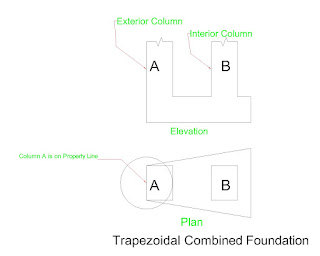
A combined footing is provided for two or more columns together under the following circumstances:

1. When one of the columns is located near the property line and the individual footings of the columns may extend outside the property line.

2. When the individual footings of the columns overlap each other due to proximity.

3. When the required area of an individual footing is more due to low bearing capacity of the soil.

This footing maybe rectangular if the two columns carry equal loads and trapezoidal if columns carry unequal loads as shown in Fig. 2.7.


elevation and plan of a combined foundation


    2.4.3. Raft Foundation:

    It is a type of shallow foundation which is most suitable for heavy structures to be built on soft and marshy soil types which can cause differential settlement of the building. The Raft foundation consists of R.C.C slab covering the entire area or a slab with beams above it. It is also known as mat foundation because RCC slab covers the entire area under the structure like a mat. It is similar to an inverted beam and slab system. Raft foundation also provides a very wide area for dispersion of structural load thus reducing the intensity of pressure considerably. This results in a reduction in the overall settlement of the building.

    2.4.4. Grillage Foundation:

This type of foundation is used only when the loads are very heavy and the soil is poor Let suppose. the bearing capacity of the soil is very low. This type of footing is much lighter and does not require deep excavation. Based upon the type of material used, the grillage foundation is of the following two types:

    2.4.4.1. Steel Grillage Foundation:

This type of foundation consists of rolled steel joists or steel beam embedded in the cement concrete. The rolled steel joists (RSJ), known as grillage beams, maybe provided in one tier or two tiers depending upon the intensity of load to be transferred. The depth of this foundation is limited to 1 to 15 m. This type of foundation is constructed as follows:

(a) The foundation is excavated to the required depth, the soil is rammed and compacted well.

(b) A concrete bed of 150 mm thickness is laid and compacted well.

(c) When the concrete bed is hardened then the first tier of grillage beams is put on the bed using spacer bars to keep the beams in position.

(d) Now the second tier of beams is put over the first tier but at right angles to the first tier.

(e) The entire space is now concreted with a minimum cover of 100 mm on all the sides of the beams. 

Figure 2.9 shows a steel grillage foundation for a steel stanchion.

    2.4.4.2. Timber Grillage Foundation:

This type of foundation is used for soils and timber beams. This type of foundation is used for soils that always remain water-logged. It consists of timber planks and timber beams. This type of foundation is constructed on a timber platform rather than a concrete block. The timber platform is made up of timber planks of 50 mm to 80 mm in thickness, placed side by side. Timber beams of size 100 mm x 120 mm are placed over the timber platform covering its full length and breadth. A heavy log of suitable dimension is placed in the center over the timber beams and the timber column is constructed above this log. The load transfer path for such a footing is as follows:


Deep Foundations

Introduction:

    The foundations that are constructed sufficiently below the ground level are called deep foundations. The depth of the deep foundation is very large as compared to its width. Deep foundations are required to be constructed in any of the following conditions:

1. The bearing capacity of topsoil is very poor and the strata of good bearing capacity deep. So the foundation has to be taken deep into the ground and unevenly distributed.

2. The structural load is heavy and unevenly distributed.

3. For structures constructed on the seashore or river bed (bridge piers), where there is the possibility of scouring action of water. In these cases, the foundation must be placed below the scouring depth, even if the suitable bearing stratum is available at shallow depth.

4. If the underground water level is high or fluctuating and it is difficult or uneconomical to pump the water from the open trenches of the shallow foundation. 

Deep foundations are of the following types:

(a) Pile foundation

(b) Pier foundation.

(c) Caisson or well foundation.

Share:

Saturday, February 27, 2021

What are foundations and its types?

FOUNDATIONS:

    Foundations are the need of every building however small buildings need shallow foundations whereas mega building needs deep foundations. Foundation is the substructure part of the building that is in direct contact with the subsoil. It is one of the most important parts that transmits all the building load to the subsoil. A properly designed foundation will transfer the loads to the subsoil, in such a way that the soil should not fail and the settlement should be within the permissible limits. Depending upon the type of soil and the type of building that is to be constructed, one may choose from various types of foundations.

Building Foundation consists of two parts :

(I) Substructure or Foundation.

(II) Superstructure.


Foundations or Substructure:

Substructure or foundations is that part of the building, which is below the ground level and is in direct contact with the soil however, It also names a foundation, and its function is to transfer the load of the building safely to the ground.

Superstructure:

The superstructure is that part of the building which is above ground level.

PURPOSE OF FOUNDATION:

    Foundations are a very important part of any structure that should fulfill its function properly otherwise the structure may collapse or become abandoned. It is provided for the following purposes: 

  1. The foundations distribute the weight of the supers structure over a larger area such that the pressure due to loads at the base of the footing does not exceed and the safe bearing capacity of the sub-soil.
  2. It transfers the load of the superstructure evenly or uniformly to the sub-soil, thus preventing the unequal or differential settlement which can cause cracking, tilt or collapse of the building
  3. .It provides a level, even, and hard surface for the construction of the superstructure.
  4. They act as anchors for the superstructure. They anchor the superstructure into the deep ground, to give lateral stability against overturning caused due to horizontal forces like wind, rain, earthquake, etc.
  5. It also provides safety against movement of moisture (in weak and poor soils) and undermining or scouring due to burrowing animals and flood water, etc.

TYPES OF FOUNDATIONS:

Foundations may be broadly classified into two types:

  1. Shallow Foundation.
  2. Deep Foundation.

The definition is given by Terzaghi:

    As defined by Terzaghi's, shallow foundations is that foundation in which the depth is equal to or less than its width. And a deep foundation is that in which the depth is greater than its width".

    The foundation constructed at a shallow depth, at the lowermost of the superstructure, is termed as the shallow foundation, and a foundation constructed at deeper depths is called a deep foundation.

TYPES OF SHALLOW FOUNDATION:

Shallow foundations are of the following types ;

(a) Spread foundation.
(b) Combined foundation.
(c) Raft foundation.
(d) Grillage foundation.

Spread Foundation:

    A spread foundation is built by providing a spread under the base of the wall or column such that to increase the distribution area for the load.

Thus, spread distributes the load on a wider area such that the safe bearing capacity of the soil is not exceeded, therefore; the spread given at the base is called footing and is called a spread foundation.


The various types of footings which come under this category are as follows:

  1. Wall Footing.
    • Stepped footing
    • Strip footing
  2. Masonry Pillar Footing.
  3. Concrete Column Footing.
  4. Inverted Arch Footing.


(1) Building Wall Footing:

    The spread footing which is built under a wall is called wall footing and is of two types:

(i) Stepped footing

(ii) Strip footing

cross section view of stepped foundation
Spread foundation

(I) Stepped foundations or footings:

Cross Section View of Spread Foundations.
Spread foundation for 400mm thick wall

Fig 2.1 Cross-Section view of Spread Foundation.

The stepped footing consists of several layers of brickwork, laid by 50 mm offset or projection on both sides of the wall, however, the thickness of each step is kept 100 mm. It may increase to 200 mm.
The bricks used in foundations should be first-class bricks in 1:3 or 1:4 cement mortar.

Construction of Stepped Foundations:

The subsoil surface is level and compacted with rammers.

A layer of sand and gravel lays over the prepared surface which is compacted well. As it provides a cushion to the footing.

A layer of lean concrete lays over this surface and compacted well with the help of rammers.

The thickness of the lean concrete (1: 3:6) or (1:4: 8) bed must not be less than 150 mm or its projection beyond the bottom-most course of the brickwork. This concrete bed provides a plain and even surface for the construction of footing.

On the concrete bed, a course of brickwork is lain in the form of steps as showing in Fig. 2.1,

By giving a 50 mm offset on both sides of the wall.
Stepped footings for a 400 mm thick and a 300 mm thick wall showing Fig. 2.1.

Stepped Foundations on Slope.
Fig 2.2 Stepped Foundation On slope.

USE:

This is the simplest type of footing and is laid under the walls of buildings. The step footing is also good on sloppy sites in the form of steps of concrete.


(ii) Strip Footing:

Sloped strip foundations for wall
Fig. 2.3 Sloped strip footing for the wall


A strip footing consists of a continuous strip under the wall. This strip is made of plain concrete or reinforced cement concrete depending upon the structural load. The use of concrete results in a reduced number of steps.

Reinforces strip footing is an economical option for the wall that carries the heavy load to poor soils because in that case, the bricks masonry footing is much larger.

Figure 2.3 shows a sloped R.C.C. strip footing provided under a wall.

(2) Masonry Pillar Foundations or Footings ;

    This type of footing is used to support the individual pillars or columns made up of brick masonry. Following is the stepped footing in Fig. 2.4.

Masonry Pillar Footings
Spread foundation with brick massonry

Conclusions:

    To summarize this, One must have to check the other post. However, shallow foundations have a variety of options to transfer the load to the subsoil.

For listening this article in Mp3 click the download button.

Share:

Featured Post

3d Stolen House Design Models

 3D model of House

Popular Posts